


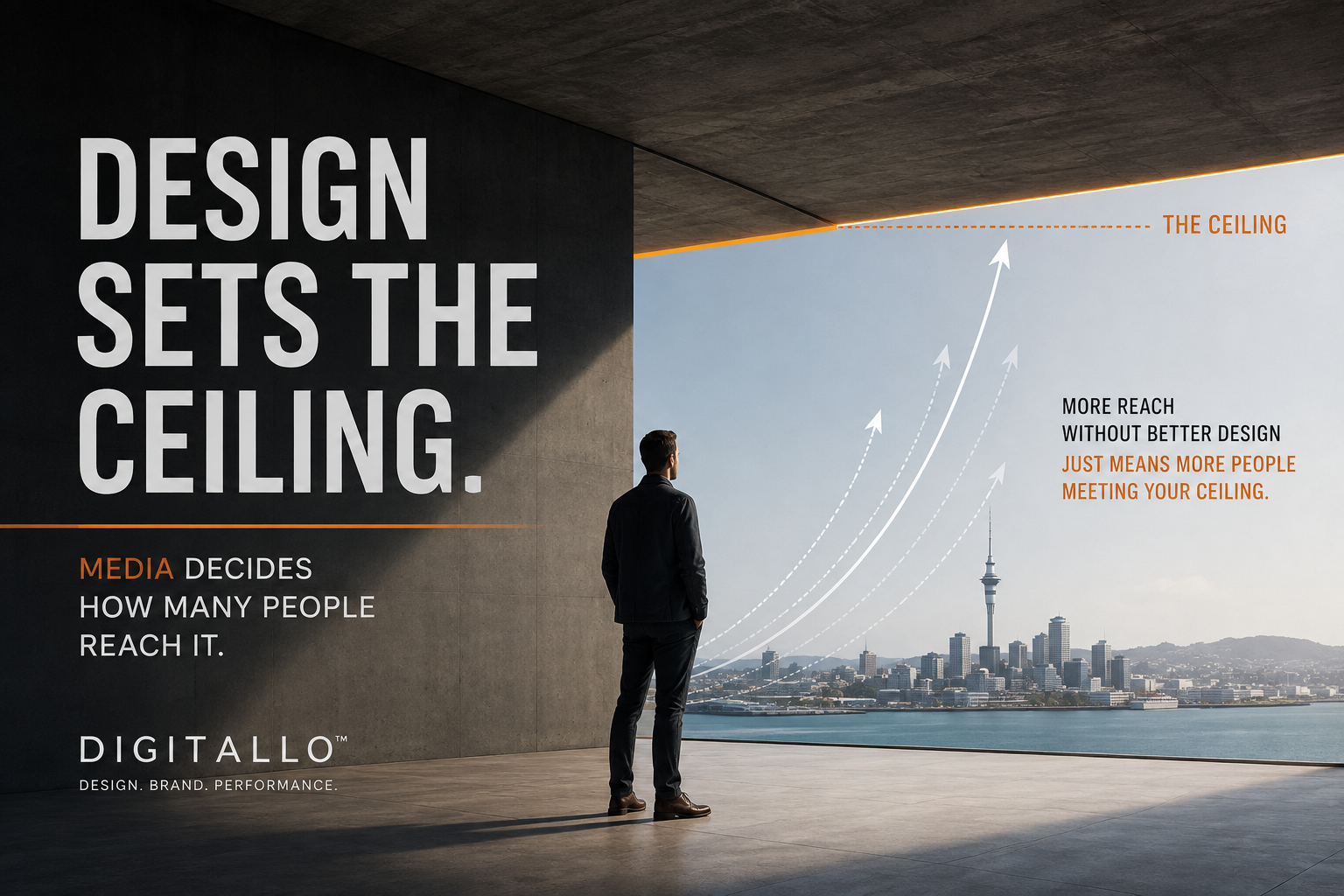
Every flat quarter produces the same proposal: move budget out of design and into reach.
More impressions. More clicks. More chances to convert.
It sounds like discipline.
It is usually the most expensive decision in the room.
Design is not separate from performance
Here is what I have come to believe after thirteen years of watching campaigns succeed and fail on both sides of the client table:
Design is not a cost sitting beside performance. It is the variable that sets how much performance is available to buy.
Media determines how many people encounter the work.
Design determines what happens when they do.
Spend more on the first without fixing the second and you have simply increased the number of people meeting your ceiling.
What does a performance test actually measure?
A performance test measures variants inside a system somebody already designed.
It can tell you which of two headlines converts better. It cannot tell you that the ceiling was set months earlier, when the hierarchy, the typography and the identity were locked.
This is not an argument against testing. Testing is honest work, and most organisations do too little of it.
But optimisation operates within a frame, and the frame is a design decision.
You can test your way to a better button. You cannot test your way out of looking like every other operator in your category.
That is the part that rarely appears in a dashboard.
The dashboard reports what happened inside the choices you made. It is silent about the choices themselves.
Which design decisions show up as numbers?
More of them than most finance teams assume.
Four mechanisms matter, and each ends in a metric a media team already reports every month.
1. Comprehension speed
Hierarchy, contrast and typographic scale decide how long it takes someone to understand what is being offered.
That duration is already being measured. It appears as bounce rate, scroll depth and time to first action.
A page that needs four seconds to explain itself, in a market that grants two, is not failing on copy.
It is failing on structure.
2. Production capacity
This is the one most often missed.
Every major platform now rewards variation because algorithms need alternatives to find an audience.
A brand with a working asset system can produce twenty variants in a day.
A brand without one briefs each execution from scratch and manages four in a fortnight.
Same budget. Same media plan. A different number of attempts.
The design system did not make the campaign prettier.
It multiplied how many times the campaign could learn.
3. Technical craft
Accessibility, page weight, colour contrast and interaction states are design decisions with unusually direct measurement.
Load performance feeds both organic ranking and paid quality signals. An inaccessible interface quietly excludes a share of every audience you have already paid to reach.
Design decisions here do not live in a separate aesthetic category. They affect how effectively the work performs.
4. Recognition
Recognition is the slowest to show and the largest when it does.
Distinctive assets — a colour, a shape, a typeface, a sound — are what allow advertising to accumulate rather than reset.
Without them, every campaign begins at zero and pays full price for attention the brand had already earned once.
The compounding effect
Notice what those four have in common.
None of them is a matter of taste.
Each is a decision that either raises or lowers the return on money already committed elsewhere.
That is what makes design an asset rather than an expense.
An expense is consumed once. An asset keeps paying.
A brand system built properly in year one is still lowering the cost of every execution in year four.
The objection
Now the strongest objection, and it is a fair one:
A great deal of design spend is genuinely unaccountable.
Rebrands get launched. Decks get applauded. Guidelines get printed, and nothing measurable moves.
I have sat in those reviews, and on occasion I have presented in them.
The discipline has not always helped itself either.
“Elevate the brand” is not a hypothesis, and a rationale that cannot survive a direct question about revenue deserves the scepticism it receives.
But the conclusion drawn from that is usually the wrong one.
The answer is not to demote design to decoration and buy more reach.
It is to brief design the way you brief media:
Against a number, with the mechanism named, instrumented before it ships.
Design that cannot say which metric it intends to move should be challenged.
So should media that cannot say why the response stopped.
What changes on Monday?
So the next time the flat quarter produces that meeting, change the question.
Not:
“Where can we cut in order to buy more reach?”
Ask instead:
What is limiting the response we already get?
Then go and look at exactly what the audience sees, in the order they see it, on the device they see it on.
Most of the answer is sitting there, and it has been for months.
And when the design team presents, ask for the mechanism rather than the mood board.
Design is not what makes the work look finished. It is what decides how far the work can go.
Brand systems built to carry performance, not just approval.
Brand strategy, identity, packaging and design systems — built to be used, measured and defended.
Auckland and Dhaka. Since 2013.